Funsize, Internal Design Tooling
Creating shared standards for roles, expectations, and growth
This content requires a password to view
As Funsize grew, designers lacked a shared framework for understanding role expectations, skill progression, and how to grow from one level to the next. There was no common language for skills, no clear rubric for progression, and no consistent way to assess growth or guide mentorship conversations.
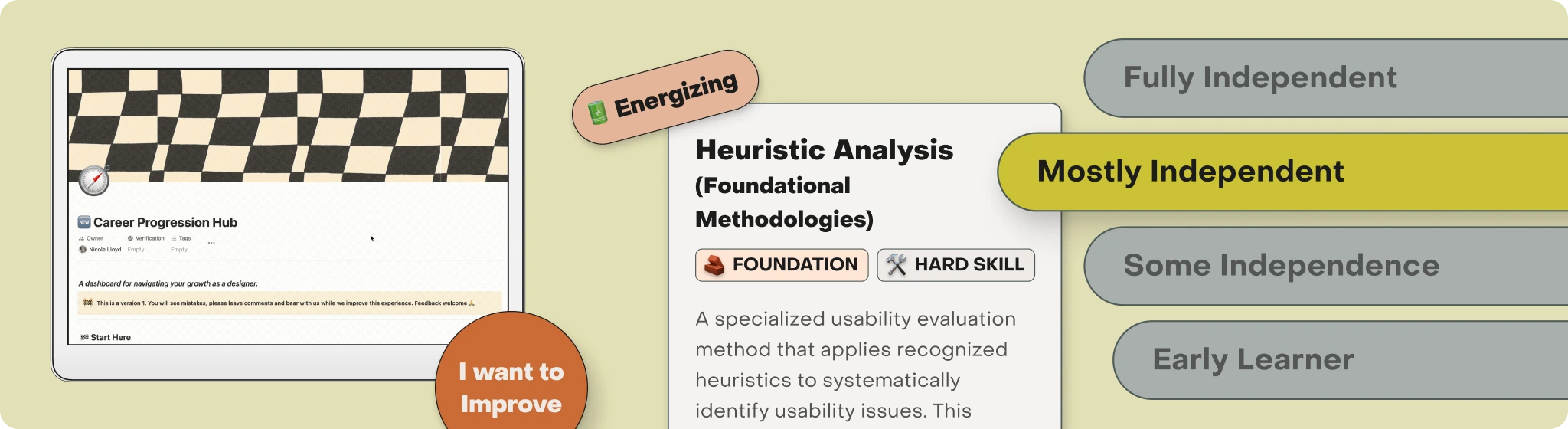
I led the design of a Career Progression Hub, an internal system that brings clarity to roles, skills, and expectations.Rather than shipping a coded product, we moved quickly and pragmatically, using **Notion** and **Figma** to create a usable MVP focused on clarity, adoption, and real-world use.
The result was a structured skills taxonomy, a role-level rubric, and a self-assessment workflow that helped designers understand where they are, what’s expected next, and how to take ownership of their growth. This project positioned design not just as execution, but as a tool for shaping culture, alignment, and shared understanding.

"QUOTE_TEXT"
–QUOTE_ATTRIBUTION
As Funsize grew, designers lacked a shared framework for understanding role expectations, skill progression, and how to grow from one level to the next. Expectations varied by project and mentor, skill definitions were inconsistent, and designers often struggled to assess where they stood or what "good" looked like at the next level.
This wasn't a tooling problem—it was a clarity problem. Designers wanted a common language for skills, transparent expectations across roles, and a way to take ownership of their growth without relying solely on ad hoc feedback.
Approach
I took full ownership of defining and designing a Career Progression Hub—a system that brings structure and shared understanding to how designers grow at Funsize.
Rather than jumping straight to tooling, I focused first on designing the underlying system:
Clarifying what skills matter and how they're defined
Separating skills from roles to reduce confusion and anxiety
Making progression visible without turning it into a checklist
Because the goal was adoption and real-world use—not a polished software product—we intentionally used Notion and Figma to move quickly, iterate in the open, and keep friction low.
Key components of the system included:
A structured skills taxonomy grouped into Core, Growth, and Specialty skills
Proficiency levels that show how skills evolve over time
A role-level rubric (L1–L5) that connects expectations to behaviors
An interactive self-assessment worksheet that supports reflection and goal setting
Throughout the process, I shared progress with leadership, gathered feedback from designers, and refined language to reduce ambiguity—without positioning this as a performance management tool.
Outcome
The Career Progression Hub shipped as a usable MVP within three months, including:
A centralized Notion hub designers could reference anytime
A Figma-based self-assessment tool to support reflection and growth planning
Clear, shared language for skills, roles, and expectations
Designers reported feeling more confident about where they stood, better equipped to discuss growth with mentors, and more empowered to drive their own development. For the organization, the system created alignment and consistency without introducing heavy process or people management overhead.
This project positioned design not just as execution, but as a tool for shaping clarity, culture, and shared understanding—demonstrating leadership through systems and influence rather than direct management.
"QUOTE_TEXT"
–QUOTE_ATTRIBUTION
As Funsize grew, designers increasingly asked the same questions:
What's expected of me at my level?
How do I know if I'm progressing?
What does "next" actually look like?
There was no shared framework for answering them. Skill definitions varied by person and project. Role expectations were implicit rather than documented. Growth conversations depended heavily on individual mentors, making the experience uneven and often ambiguous.
This wasn't a tooling gap—it was a clarity gap. Designers wanted transparency, shared language, and a way to understand their growth without relying solely on informal feedback.
Problem
Funsize lacked a clear, consistent system for defining:
Design skills and how they evolve
Expectations across roles and levels
How designers could assess where they were and what to work on next
Without this clarity:
Designers felt uncertain about expectations
Growth conversations were harder than they needed to be
Skills were often conflated with titles or tenure
How might we design a system that brings clarity to growth—without turning it into a rigid checklist or a people-management tool?
Goals
The goal was to create a shared, usable framework that:
Clearly defines design skills and expectations
Shows how skills evolve across levels
Helps designers assess themselves and identify growth areas
Supports better mentor conversations
Encourages ownership of development
Just as importantly, the system needed to feel supportive, flexible, and human—not evaluative or punitive.
Strategic Framing
This project required leadership, but not people management.
I approached it as a systems design problem:
Design shared language
Reduce ambiguity
Make expectations visible
Empower individuals to drive their own growth
Rather than waiting for a formal process or tooling investment, we focused on building something practical, testable, and immediately useful.
Designing the System
Defining Our Skills
The first step was creating a clear, navigable skills foundation by:
Refining the existing skill list and clarified definitions
Grouping skills into Core, Growth, and Specialty categories
Loosely mapped skills to Funsize service offerings
Structuring the content for easy navigation and reference
To show progression over time, I introduced proficiency levels—not as grades, but as descriptions of how skills evolve with experience.
Why this mattered:
Without shared definitions, designers were rating themselves against different mental models. Clarity here was foundational.
Separating Skills from Roles
A key tension surfaced early: designers often interpreted skill ratings as role qualifications.
To address this I:
Explicitly separated skills from roles
Designed role descriptions that focused on behaviors and expectations
Introduced a rubric that showed how skills show up differently at each level
This helped reduce anxiety and reframed growth as progression, not judgment.
Creating a Self-Assessment Tool
To make the system actionable, I designed an interactive self-assessment worksheet in Figma.
Designers could:
Rate confidence across skills
Reflect on strengths and gaps
Define goals and areas of focus
This tool encouraged reflection without prescribing outcomes—and became a useful artifact for mentor conversations.
Why Figma:
It was familiar, flexible, and allowed us to prototype behavior without engineering overhead.
Building the Role-Level Rubric
I created a role-level rubric spanning L1–L5, including:
Clear expectations per level
Behavioral indicators
Growth-focused language
To add nuance without rigidity, I introduced Walking / Jogging / Sprinting bands to describe how designers grow within a level.
Testing revealed that while the rubric worked well, the bands felt abstract—an insight that shaped future iteration.
Testing & Feedback
I conducted four qualitative interviews with designers to understand:
Whether the system felt clear and usable
Where language still caused confusion
How designers interpreted skill ratings and roles
What worked well:
The rubric helped visualize growth
The worksheet supported reflection
Language felt approachable and clear
What needed refinement:
Skill-to-role mapping needed more clarity
Bands required better explanation and examples
This feedback reinforced the value of shipping something usable, then improving it through real use.
Shipping an MVP
Rather than waiting for perfection, we shipped a working MVP that included:
A centralized Notion hub for skills, roles, and documentation
The Figma self-assessment worksheet
Short how-to videos explaining how to use the system
Using Notion allowed us to:
Move quickly
Lower adoption friction
Iterate in the open
The goal wasn't polish—it was usefulness.
Outcome
Within three months, the Career Progression Hub became a shared reference point for designers at Funsize.
Designers:
Felt clearer about expectations
Had better tools for growth conversations
Felt more ownership over their development
The organization gained:
Shared language around skills and roles
Greater consistency without heavy process
A foundation that could evolve over time
This work demonstrated how design can shape culture and clarity—leading through systems and influence rather than formal authority or people management.
Learnings
Clear UX writing is critical when designing abstract systems
Designers benefit from context more than complexity
Shipping something usable accelerates learning more than waiting for alignment
Challenges
Managing the complexity of skills, levels, and bands
Untangling skills from perceived role qualifications
Designing for digestibility without oversimplifying
Wins
Fully owned a complex, high-impact internal initiative
Turned vague expectations into a structured, usable system
Shipped an MVP quickly while leaving room to evolve
What I'd Do Next
With more time, I'd refine skill-to-role mapping—especially at senior levels—and explore ways to make progression more dynamic while preserving clarity.
"Not only did Nicole almost single-handedly produce all aspects of our career progression hub, she was also instrumental in helping refine and clarify it's vision and intent. When I saw the MVP release I was blown away at its thoughtfulness and thoroughness."
— Lee Brenner, Head of Design
Context
DETAILS_CONTEXT_PARAGRAPH_1
DETAILS_CONTEXT_PARAGRAPH_2
Problem
DETAILS_PROBLEM_DESCRIPTION
Sub-problem heading
Problem point 1
Problem point 2
Problem point 3
How might we... question here?
Goals
DETAILS_GOALS_INTRO
Our goals were to
Goal 1
Goal 2
Goal 3
Goal 4
Discovery & Alignment
Discovery content here.
Discovery point 1
Discovery point 2
Discovery point 3
Conclusion paragraph.

Competitive Analysis
Competitive analysis intro.
Competitor 1: Description.
Competitor 2: Description.
Competitor 3: Description.
Conclusion about positioning.

Personas & User Journeys
Personas intro paragraph.
Journey description paragraph.


Key Features & Deliverables
Features intro paragraph.
Feature 1
Feature 2
Feature 3
Feature 4
Conclusion paragraph.
Outcome
DETAILS_OUTCOME_PARAGRAPH_1
DETAILS_OUTCOME_PARAGRAPH_2
"QUOTE_TEXT"
–QUOTE_ATTRIBUTION
What I'd do next
Next steps paragraph.
Learnings
Learning 1
Learning 2
Learning 3
Challenges
Challenge 1
Challenge 2
Challenge 3
Wins
Win 1
Win 2
Win 3
